
Tamil Nadu · South India
Rameshwaram
An island temple where the rails run out
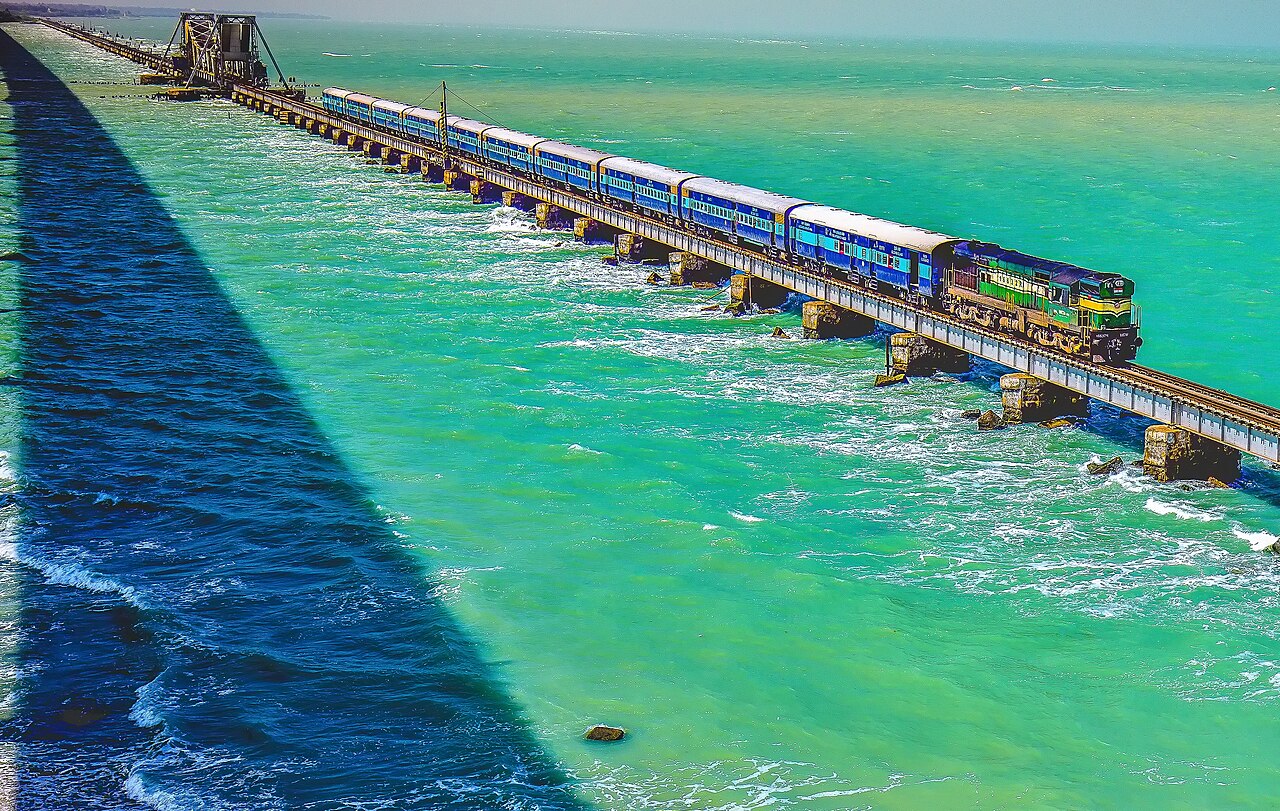
A train on the old Pamban Bridge · Photo: Shaswat Nimesh, CC BY-SA 4.0
An island reached across the sea
Rameshwaram is an island, and the crossing is part of the pilgrimage. For more than a century trains reached it over the Pamban Bridge, opened in 1914 with a lifting span for ships; in April 2025 a new bridge beside it took over, its central span rising vertically to let boats through, and the old bridge was retired. Pilgrims have been coming far longer. The Ramayana says Rama worshipped Shiva here on his return from Lanka, and the line of shoals running towards Sri Lanka is still called Rama's bridge.
At the island's tip lies Dhanushkodi, a town erased in a single night by the cyclone of December 1964, which also swept away a train. Its church and railway station stand roofless in the sand. Since 2017 a road has run past them to Arichal Munai, where the land simply stops and the two seas meet. The island is also where A. P. J. Abdul Kalam was born and is buried; his memorial stands at Pei Karumbu.
Twenty-two wells and a long corridor
The Ramanathaswamy temple is the reason for everything. Its corridors, built up mainly by the Sethupathi rulers of Ramnad in the seventeenth and eighteenth centuries, run for hundreds of metres under carved pillars and painted ceilings, and the outer one is among the longest in any Indian temple. Pilgrims first bathe in the sea at Agni Theertham, then move through the temple's twenty-two wells, each said to have its own virtue, with an attendant pouring a bucket of water over their heads at every one. Mahalaya Amavasya, in September or October, brings vast crowds to perform rites for ancestors at the shore.
Food splits two ways. Near the temple, it is pilgrim food — banana-leaf meals, sambar, curd rice, sweet pongal at the prasad counters, and sundal sold on the beach. Out by the fishing harbours it is the sea: squid fry, prawn masala, meen kuzhambu and crab. Karupatti coffee, sweetened with palm jaggery, is worth seeking out at the small shops.
The honest logistics
- Best monthsOctober to March. April to June is fierce; the northeast monsoon can bring heavy rain and cyclone warnings in November and December.
- Getting thereMadurai (IXM) is the nearest airport, about 170 km and three and a half to four hours by road. Trains run to Rameswaram station from Madurai and Chennai over the new Pamban Bridge.
- StayingSimple lodges and pilgrim hotels near the temple; a few quieter hotels towards the sea.
- Days neededTwo days: one for the temple and its wells, one for Dhanushkodi and the Kalam memorial.
- Budget feelComfortable from ₹1,800/day; the better hotels from ₹4,500/day.
Local cuisine & must-try dishes
Festivals & celebrations
What a Saint will tell you
If you do the twenty-two wells, wear clothes you don't mind soaking and carry a change in a plastic bag — and expect to tip the attendants. Agni Theertham is calm at dawn and crowded by eight. Dhanushkodi is best in the morning light; be off the spit before dusk, as travel out there is restricted after dark, and do not swim at Arichal Munai, where the currents are dangerous. Drive over the Pamban road bridge at least once for the view down onto the railway lines.
Being a good guest
Rameshwaram's waters are part of the Gulf of Mannar marine park, one of India's richest reef areas, so never buy coral, shells or dried seahorses sold on the beach. Keep soap and plastic out of the holy wells and the sea. Dress conservatively in the temple, where only Hindus may enter the inner sanctum, and remember that many people here are performing rites for the dead.
Where this path continues
Rameshwaram is the end of the Tamil temple trail, and most pilgrims reach it from Madurai, four hours inland — the city of the Meenakshi temple, its towers painted brighter than anything in the south.