
Rajasthan · The Thar Desert
Jaisalmer
A fort with a town still living inside it
Sonar Quila, Jaisalmer
A toll booth that turned into gold
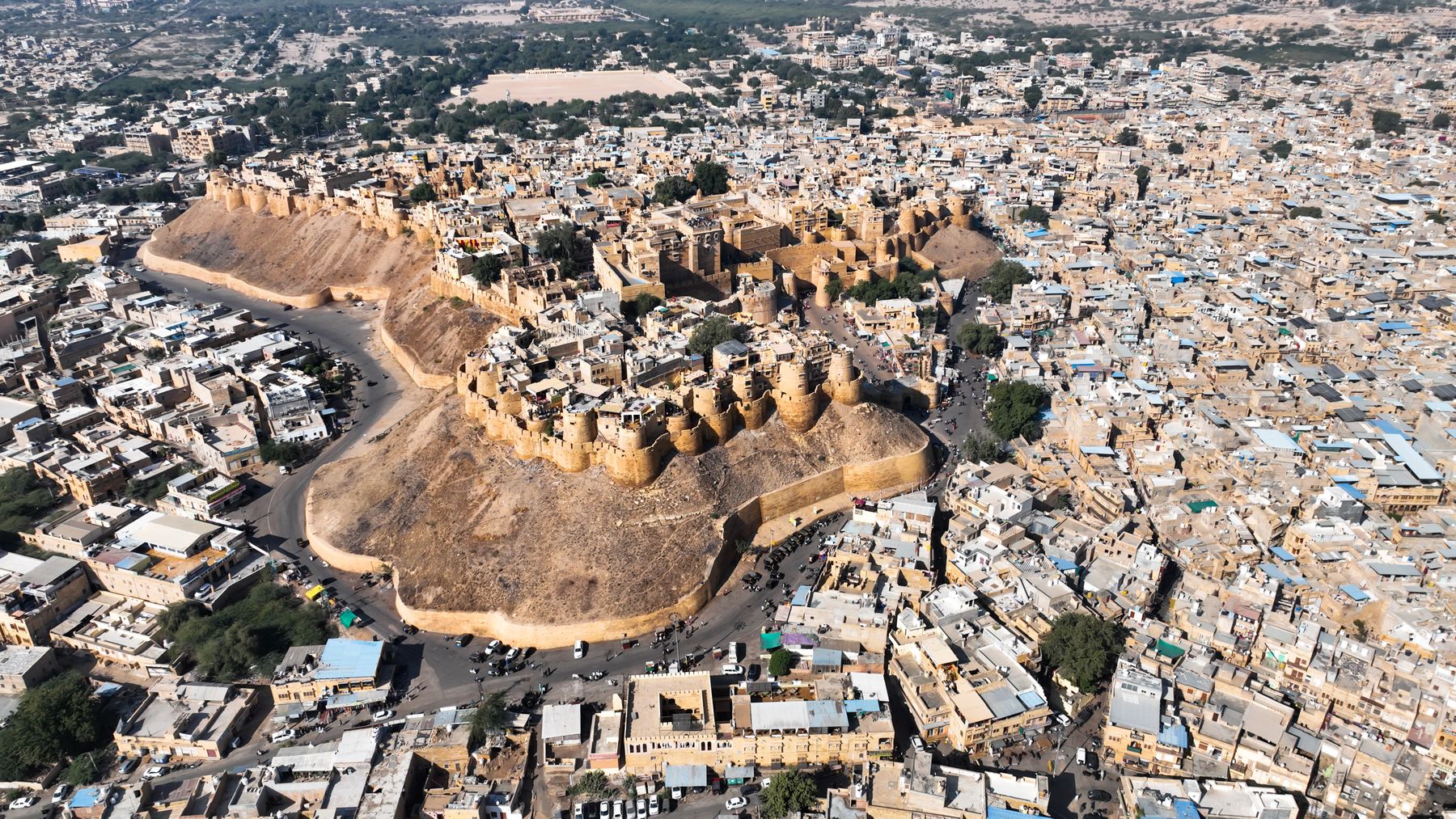
Jaisalmer was a customs post. Founded in 1156 on a ridge of yellow sandstone, it grew wealthy taxing camel caravans moving between India and Central Asia, then went quiet when ships took that trade away. What money left behind was architecture — merchant havelis carved like lacework, and a fort nobody ever bothered to abandon.
Several thousand people still live inside Sonar Quila, behind walls that turn the colour of honey an hour before sunset. It is one of very few living forts left on Earth, which is both the wonder of the place and its central problem.
The desert's musicians and its stone carvers
This is Manganiyar and Langa country — hereditary musician communities who have played for the same patron families for generations, and whose songs are the real reason to stay out after dark. Ask for a courtyard performance rather than a dune-top show arranged around a bus.
The havelis are the other art form. Patwon ki Haveli was built by one jeweller family in five parts; Nathmal ji's was carved by two brothers working inward from opposite ends, and the halves do not quite match. Up in the fort, the fifteenth-century Laxminath temple has been the royal household's shrine ever since it was built — Vishnu and Lakshmi, a sensible dedication for a city that lived on customs duties — and it still fills for morning aarti. The food is desert food — ker sangri, gatte ki sabzi, millet rotis, and far more ghee than you expect.
The honest logistics
- Best monthsOctober to March. The Desert Festival falls around February's full moon; May and June are genuinely punishing.
- Getting thereOvernight train from Delhi or Jaipur; Jodhpur is about five hours by road. Jaisalmer airport (JSA) runs seasonal flights only.
- StayingSleep outside the fort walls, not inside — see below. Old-town havelis, plus one night at a desert camp.
- Days neededTwo days and one desert night is the honest answer; three if you want Khuri or Kuldhara properly.
- Budget feelComfortable from ₹2,000/day; a well-run desert camp from ₹6,000/night.
What a Saint will tell you
Skip Sam dunes at sunset — it is a car park with camels in it. Khuri and Damodara are an hour further out and quiet, and that difference is the whole trip. Go to Gadisar Lake at first light, when it belongs to washerwomen and pigeons. And visit Kuldhara, the abandoned village, with someone who can tell you which parts of the story are history and which are ghost tour. And if the border country pulls you deeper, Tanot Mata's temple, about two hours north, is kept by the Border Security Force — the shells that fell around it in 1965 and 1971 and failed to explode sit in a glass case, which is roughly why the soldiers run the shrine themselves.
Being a good guest
The fort was built for a few hundred people and now carries the plumbing of thousands. Seepage is undermining its foundations and bastions have collapsed. Stay outside the walls, visit inside by day, and spend your money there. Carry your bottles back from the dunes — nobody else is going to.
Where this path continues
Jaisalmer pairs naturally with Jodhpur, five hours east, where the desert stops against a blue city and a fort of an entirely different temperament. Pushkar suits you instead if what you liked was the quiet.