
Madhya Pradesh · Central India
Khajuraho
A thousand years of stone, mostly misread
The western group of temples
Eighty-five temples, twenty-five survivors
The Chandela kings built perhaps eighty-five temples here between roughly 950 and 1050 CE, then the dynasty faded and the forest closed over the site. Twenty-five survive. For most of seven centuries almost nobody came, until a British engineer, T. S. Burt, was carried out here in 1838 and wrote about what he found — after which Khajuraho re-entered the world already famous for the wrong reason.
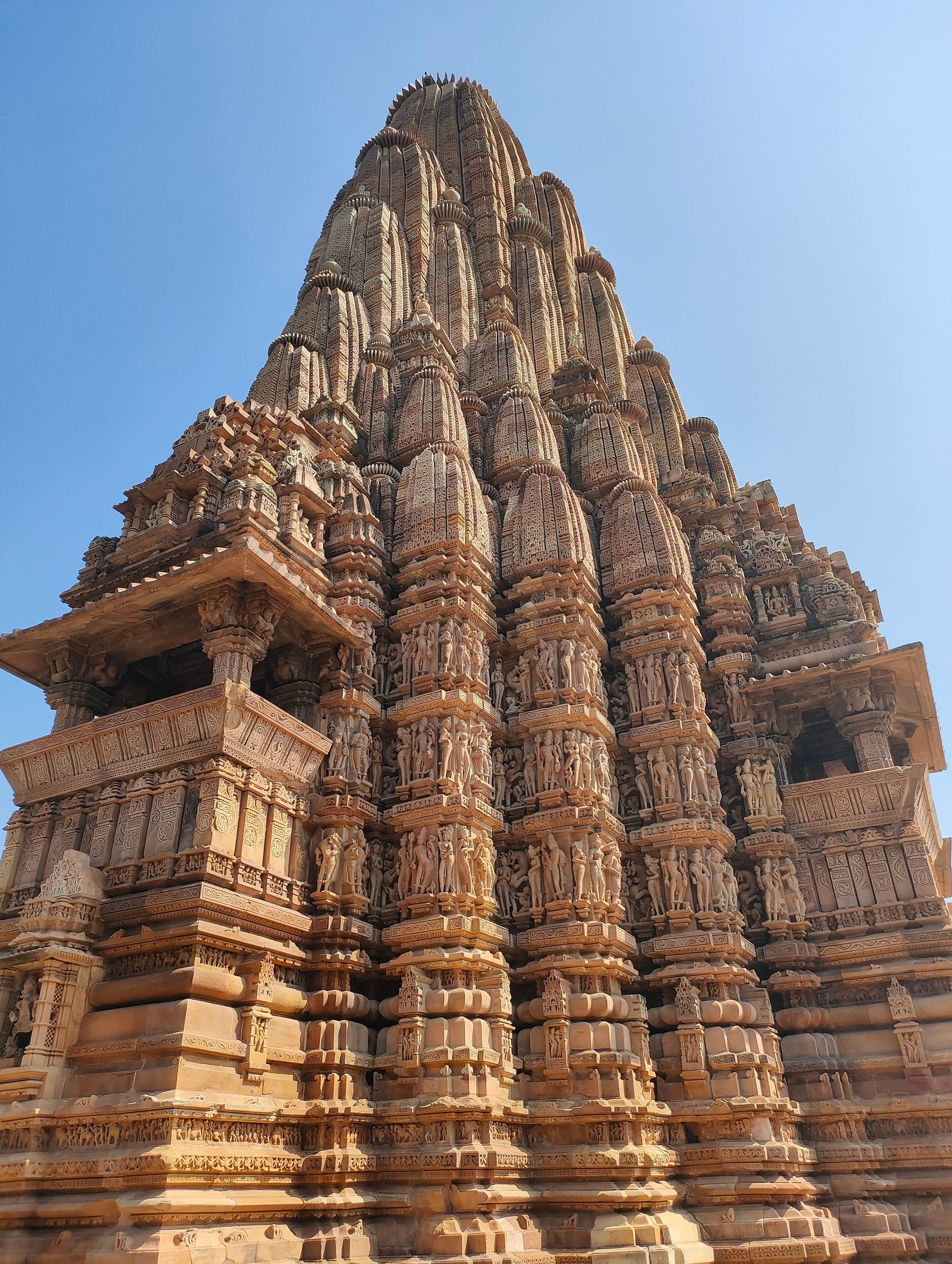
The erotic carvings are real, and they are a small fraction of the sculpture on any given wall. Look past them and the temples turn into a stone catalogue of ordinary life: a woman writing a letter, a musician tuning, a man pulling a thorn out of his foot. The largest of the survivors, the Kandariya Mahadeva of about 1030, is dedicated to Shiva: its thirty-metre shikhara is built up from eighty-four smaller spires so that the whole temple reads as a mountain, which is the point — Shiva lives on one.
Bundelkhand, quietly
This is Bundelkhand — dry, agricultural, a long way from anywhere, and much poorer than the visitor numbers suggest. Khajuraho village is small enough to cross on foot in twenty minutes. The main temples now sit inside a mowed lawn, which does them no favours; they were built to be walked up to through trees.
Every February the Khajuraho Dance Festival puts classical dancers — Kathak, Odissi, Bharatanatyam — on an open stage in front of the western temples. It is the one week of the year when the sculpture and the living tradition it came out of stand in the same light. Worship never entirely left, either: Matangeshwar, beside the western group but outside the ticketed enclosure, has kept its two-and-a-half-metre Shiva linga in daily use for a thousand years, and its Maha Shivaratri fair in February or March is still the biggest week on the village calendar.
The honest logistics
- Best monthsOctober to March. April to June is punishing heat; the monsoon greens everything but closes Panna.
- Getting thereFly to Khajuraho (HJR) from Delhi or Varanasi, or take the direct train. Jhansi, 175 km away, is the reliable rail fallback.
- StayingA handful of good hotels near the western group; plain, cheap guesthouses in the village itself.
- Days neededTwo — one for the western group, one for the eastern, Jain and southern temples plus Panna.
- Budget feelFrom ₹2,000/day simply; around ₹5,500/day for real comfort.
What a Saint will tell you
Be at the western group when it opens, before the coaches arrive from Jhansi — low sun does what floodlights cannot. Then hire a bicycle and ride out to the eastern and southern temples, which stay half-empty all day and let you stand alone in front of a thousand-year-old wall. Skip the evening sound-and-light show unless you want the story told loudly.
Being a good guest
Do not touch the carvings; a great many palms have already worn some panels smooth. Ignore guides who lead with the erotic panels and ask about the iconography instead — the good ones know it well. Buy from the village rather than the hotel lobby, and book Panna's safaris through the forest department, not through touts.
Where this path continues
From Khajuraho the classic move is east to Varanasi — an overnight train, or forty minutes by air — trading temples built as sculpture for a city that is itself the shrine. The same Shiva worshipped daily at Matangeshwar presides there over three thousand years of riverfront.