
Uttarakhand · The Indian Himalaya
Almora
A ridge town that faces the snows
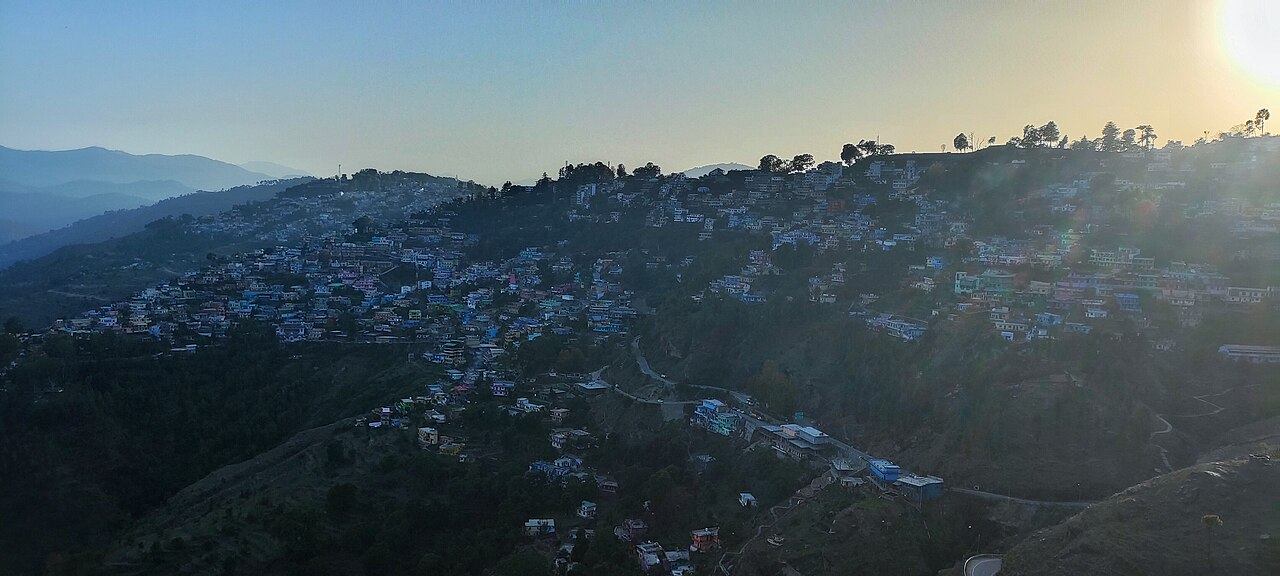
Almora at sunset · Photo: ArmouredCyborg, CC BY-SA 4.0
A capital on a saddle of rock
Almora is built along a horseshoe-shaped ridge at about 1,650 metres, and it was a capital before it was ever a hill station. The Chand kings moved their seat here from Champawat in the sixteenth century; the Gorkhas held it for a quarter-century from 1790; the British took it in 1815 and left a cantonment, a jail and a few churches. The old town never got the Mall Road treatment. Its spine is still a stone-flagged bazaar of wooden-fronted shops.
It has been a place people come to think. Swami Vivekananda stayed in the 1890s. Uday Shankar ran his dance centre here in the late 1930s. And on Kasar Devi ridge, a few kilometres out, a line of Western seekers — scholars, Buddhists, poets, then the counterculture of the sixties — made 'Crank's Ridge' a name that still turns up in memoirs.
Temples, aipan and brown sweets
The Kumaoni year is marked in small rituals. At Phool Dei in March children leave flowers on every threshold. Aipan — red-earth floors painted with patterns in white rice paste — still appears at doorways for festivals. The Nanda Devi fair in late summer gathers the hills at the temple in town, and Almora's Dussehra is its own thing: neighbourhoods build towering effigies of Ravana's whole family and parade them before the burning.
Further out, faith is in stone. Jageshwar, about 35 km away, is a valley of more than a hundred shrines under deodars, many of them over a thousand years old. Chitai Golu Devta, closer to town, is hung with thousands of bells and the written petitions of people asking a local god for justice. Then there is the food: bhatt ki churkani, a dark gravy of black soybeans; madua roti from finger millet; and two sweets the whole state associates with Almora — bal mithai, a brown fudge studded with sugar balls, and singori, wrapped in a leaf cone.
The honest logistics
- Best monthsMarch to June and September to November. October and early November give the clearest views; spring often brings haze and forest-fire smoke.
- Getting therePantnagar (PGH) is the nearest airport, about four hours by road. Kathgodam is the railhead, three hours below; Delhi to Kathgodam is an easy overnight or day train.
- StayingKasar Devi road for views and quiet; the old town for bazaars; forest lodges inside Binsar for silence. Government KMVN rest houses are plain but well placed.
- Days neededThree days covers the town, Jageshwar and Binsar. Add a night at Kausani for a sunrise over Trishul.
- Budget feelComfortable from ₹2,000/day; heritage and forest lodges from ₹6,000/day.
Local cuisine & must-try dishes
Festivals & celebrations
What a Saint will tell you
The snows are a matter of luck and season. After autumn rain the whole wall — Trishul, Nanda Devi, the Panchachuli peaks — stands out at dawn; in May you may not see a single summit for a week. Go up to Zero Point in Binsar early, before the haze rises, and walk the last stretch through oak forest rather than rushing it. In Lal Bazaar, buy bal mithai from a shop that makes it on the premises. At Jageshwar, arrive before the day-trippers from Nainital and you may have the inner courtyard to yourself and the priests.
Being a good guest
Kumaon's pine slopes burn every dry season, often from carelessness; never drop a cigarette or light a fire in the forest. Water is scarce on the ridge in summer, so use it sparingly. Leopards live close to town — keep to lit paths at night and don't leave food out. Stay in village homestays where you can, and take your plastic back down the hill.
Where this path continues
Almora sits between the busy lake at Nainital and the forests of the terai below. Travellers who loved its quiet often go down to Jim Corbett next — four or five hours away, sal forest instead of pine, and the chance of a tiger at the edge of a road.